
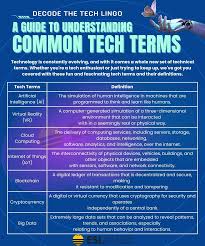
Understanding Common Technology Terms
In today’s digital age, technology is an integral part of our daily lives. From smartphones to smart homes, understanding the terminology associated with technology can be beneficial. This article explores some common tech terms that are often encountered.
Artificial Intelligence (AI)
Artificial Intelligence refers to the simulation of human intelligence in machines designed to think and act like humans. AI applications include speech recognition, decision-making, and visual perception, all aimed at making devices smarter and more efficient.
Internet of Things (IoT)
The Internet of Things describes a network of physical objects embedded with sensors, software, and other technologies to connect and exchange data with other devices and systems over the internet. This connectivity allows for smarter homes and improved industrial processes.
Cloud Computing
Cloud computing involves delivering various services over the internet, including data storage, servers, databases, networking, and software. Instead of owning their own computing infrastructure or data centres, companies can rent access to anything from applications to storage from a cloud service provider.
Blockchain
Blockchain is a system of recording information in a way that makes it difficult or impossible to change or hack the system. It is essentially a digital ledger of transactions duplicated across a network of computers on the blockchain.
Virtual Reality (VR) & Augmented Reality (AR)
Virtual Reality refers to an artificial environment created with software that users can interact with in a seemingly real way using special electronic equipment such as headsets with screens inside or gloves fitted with sensors.
Augmented Reality involves overlaying visual elements onto the real world through devices like smartphones or glasses, enhancing what we see by adding layers of digital information directly onto it.
Big Data
The term ‘Big Data’ refers to large volumes of data that inundate businesses on a day-to-day basis. But it’s not just the amount that’s important; it’s what organisations do with it that matters. Big Data can be analysed for insights leading to better decisions and strategic business moves.
Cybersecurity
Cybersecurity involves protecting systems connected to the internet from threats in cyberspace such as hacking attacks or data breaches intended for stealing sensitive information or disrupting operations.
The Importance of Staying Informed
The rapid pace at which technology evolves means staying informed about these terms is essential for both personal use and professional advancement. As new innovations continue emerging on this ever-evolving landscape understanding these foundational concepts will help navigate future developments confidently.
By familiarising oneself with these terms one gains not only knowledge but also empowerment in engaging effectively within today’s tech-driven world.
Six Advantages of Technology: Transforming Communication, Efficiency, Innovation, Access, Immersion, and Security
- Enhances communication and collaboration in various industries.
- Facilitates automation of repetitive tasks, increasing efficiency and productivity.
- Enables the development of innovative solutions to complex problems.
- Empowers individuals with access to vast amounts of information and resources.
- Supports the creation of immersive experiences through virtual and augmented reality technologies.
- Strengthens cybersecurity measures to protect sensitive data and digital assets.
Challenges of Technology Terminology: Navigating Jargon, Rapid Changes, and Complexity
- 1. Jargon Confusion
- 2. Rapid Changes
- 3. Misinterpretation Risk
- 4. Overwhelming Complexity
- 5. Exclusivity Barrier
- 6. Alienation Effect
Enhances communication and collaboration in various industries.
The proficiency in technology terms enhances communication and collaboration across various industries, fostering efficiency and innovation. By understanding and utilising tech terminology, professionals can effectively convey ideas, share information, and work together seamlessly on projects. This shared language facilitates smoother interactions, breaks down communication barriers, and enables teams to leverage digital tools for enhanced productivity and creativity. In an increasingly interconnected world, the ability to communicate using technology terms is a valuable asset that drives progress and success in diverse sectors.
Facilitates automation of repetitive tasks, increasing efficiency and productivity.
One significant advantage of technology terms is their ability to facilitate the automation of repetitive tasks, ultimately leading to increased efficiency and productivity in various industries. By understanding and implementing automation processes enabled by technology, businesses can streamline operations, reduce human error, and allocate resources more effectively. This not only saves time but also allows employees to focus on more strategic and creative tasks, driving innovation and overall performance within organisations.
Enables the development of innovative solutions to complex problems.
Technology terms enable the development of innovative solutions to complex problems by providing a common language and framework for discussing and implementing advanced technological concepts. With a shared understanding of terms like Artificial Intelligence, Internet of Things, and Blockchain, experts can collaborate more effectively to create groundbreaking solutions that address intricate challenges across various industries. By leveraging these terms and the technologies they represent, professionals can push the boundaries of innovation and drive progress towards solving complex problems in ways previously thought impossible.
Empowers individuals with access to vast amounts of information and resources.
The proliferation of technology terms empowers individuals by granting them access to vast amounts of information and resources. In a world where knowledge is key, understanding these terms opens doors to a wealth of data, insights, and tools that can enhance personal growth, professional development, and overall efficiency. With the ability to navigate and comprehend tech terminology, individuals can leverage this wealth of information to make informed decisions, stay current with trends, and harness the power of technology to improve their lives and contribute meaningfully to society.
Supports the creation of immersive experiences through virtual and augmented reality technologies.
The advancement of technology terms supports the creation of immersive experiences through virtual and augmented reality technologies. By harnessing the power of virtual and augmented reality, users can delve into interactive digital environments that blur the lines between the real world and the virtual realm. Whether exploring distant lands, engaging in realistic simulations, or enhancing educational experiences, these technologies open up new possibilities for entertainment, learning, and communication like never before.
Strengthens cybersecurity measures to protect sensitive data and digital assets.
Incorporating advanced technology terms strengthens cybersecurity measures, enhancing the protection of sensitive data and digital assets. By utilising cutting-edge tools and techniques such as encryption, firewalls, and intrusion detection systems, organisations can fortify their defences against cyber threats. This proactive approach not only safeguards valuable information but also instils confidence in users, clients, and stakeholders regarding the security of their data in the digital realm.
1. Jargon Confusion
Navigating the realm of technology can often be challenging due to the prevalence of jargon and acronyms that may leave individuals unfamiliar with the industry feeling perplexed. The abundance of technical terms can create a barrier to understanding for those seeking to engage with technology-related concepts. This jargon confusion can hinder effective communication and lead to misunderstandings, highlighting the importance of simplifying complex terminology to ensure inclusivity and accessibility in the tech discourse.
2. Rapid Changes
In the realm of technology, one significant drawback lies in the rapid changes that define the landscape. The ever-evolving nature of technology results in constant updates to terminologies and concepts, making it a challenge for individuals to stay abreast of the latest developments. This fast-paced evolution can create a sense of constant catch-up, requiring continuous learning and adaptation to remain relevant in an environment where new terms and innovations emerge at a swift pace.
3. Misinterpretation Risk
Misinterpretation Risk is a significant con associated with technology terms. Misunderstanding these terms can result in miscommunication and misinterpretation of information, which in turn may lead to errors. Whether in professional settings or everyday conversations, the incorrect interpretation of technology terms can have far-reaching consequences, affecting decision-making processes and overall understanding. It is crucial to ensure clarity and accuracy in the use and interpretation of technology terminology to prevent such risks and promote effective communication in all contexts.
4. Overwhelming Complexity
The overwhelming complexity of certain technology terms poses a significant challenge for individuals who are not well-versed in technical jargon. These intricate terms can create barriers to understanding, hindering non-experts from fully comprehending the implications and significance of technological advancements. As technology continues to advance at a rapid pace, bridging the gap between complex terminology and everyday comprehension becomes crucial to ensure inclusivity and accessibility in the digital age.
5. Exclusivity Barrier
The Exclusivity Barrier posed by the exclusive use of tech terms in communication can inadvertently alienate individuals who are not well-versed in the jargon. This barrier may create a divide between those who are tech-savvy and those who are less familiar with the terminology, leading to misunderstandings and hindering effective communication. It is crucial to strike a balance in using technical language, ensuring that all parties involved can comprehend and engage in meaningful dialogue without feeling excluded or overwhelmed by complex terms.
6. Alienation Effect
The Alienation Effect, a con of technology terms, arises from the overreliance on complex jargon in conversations or content creation. When individuals inundate their discourse with technical terminology, it can create a barrier for audiences who may not be well-versed in such language, leading to feelings of exclusion and confusion. This alienation effect hinders effective communication and can disconnect individuals from engaging meaningfully with the subject matter, highlighting the importance of striking a balance between technical precision and accessibility in discussions involving technology terms.
Author

manually@ipower.eu
Related Posts

Today’s Technology News: Unveiling Innovations and Breakthroughs
Today’s Technology News Today’s Technology News: Innovations and Updates The world of technology is ever-evolving, with new developments and breakthroughs emerging almost...
Read out all
Fuel Your Fitness: The Essential Guide to Pre-Workout Snacks
The Power of a Pre-Workout Snack The Power of a Pre-Workout Snack Preparing your body for a workout is crucial to maximising...
Read out all
Unleashing the Potential of All Technology: A Journey Through Innovation and Progress
The Evolution of All Technology: From Past to Future Technology is an ever-evolving force that shapes the way we live, work, and...
Read out all
Exploring the Latest Developments in Technology: A Glimpse into the Future
Latest Developments in Technology: A Glimpse into the Future The world of technology is ever-evolving, with new breakthroughs and innovations emerging at...
Read out all
Unveiling the Essence: What Defines Technology in Today’s World
What Defines Technology What Defines Technology Technology is a term that often evokes images of smartphones, computers, and futuristic gadgets. While these...
Read out all
Exploring the Exciting Realm of New Tech Innovations
The Latest Innovations in New Technology The world of technology is ever-evolving, with new advancements and innovations emerging at a dizzying pace....
Read out all